
This post may contain affiliate links, which means The Budgie Academy may receive a commission if you purchase through my link, at no extra cost to you. Read the full disclosure here.
Perches are an essential part of every budgie cage and playstand. Choosing the right perch collection impacts more than just your budgie’s foot health–it plays a crucial role in their overall wellbeing! Here are five of our tried-and-true tips for choosing the best perches.
Choose Natural Wood
Natural, non-toxic woods (i.e., not treated with pesticides or other chemicals) are preferred. Some good, easily-accessible choices include manzanita, grapewood, and java wood. Here are a few of our favorites, including enrichment-added options.
Offer a variety of sizes.

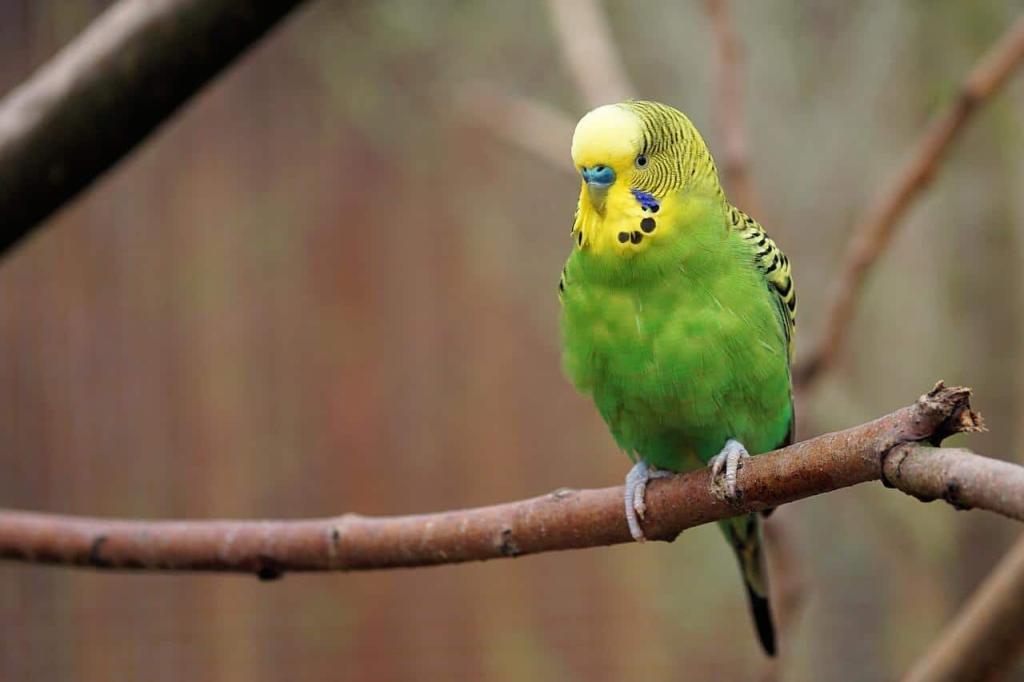
In the wild, budgies perch on branches of countless shapes and sizes, allowing their feet to flex in many ways. Offering a variety of differently-sized perches in your budgie’s cage is the best way to imitate a natural environment and ensure your bird is exercising their foot and leg muscles.
Avoid frayed rope
Frayed rope is often marketed as a “preening” item, but cotton or synthetic fiber rope can be ingested and cause impactions in your bird’s digestive tract. If you’d like to learn more about the often-overlooked dangers of ropes and other cage items, check out our article here.
Rotate Your Perches

Budgies tend to sleep on the highest perches for safety and can end up sleeping on the same perch night after night. Rotate and rearrange perches every few weeks so they’re not always sleeping on the same perch. In addition to providing a variety of perches, this will help ensure your bird’s feet don’t become habituated to just one type of surface.
Avoid dowel perches (or use wisely)!

Dowel perches are the round, smooth, simple wood perches that come with almost any cage. The important thing to recognize about these perches is that they have no variation in shape, thickness, or texture. Consequently, a budgie that uses a dowel perch long-term is continuously putting pressure on the same part of their foot for many hours a day, every day. This can lead to pressure sores, foot pain, and other health issues down the road.
But you don’t necessarily need to swear off dowel rods altogether! The key to safe use is exposure time. While your bird shouldn’t be spending hours standing or sleeping on this kind of perch, some limited use for short periods of time will not cause issues. In fact, placing a dowel perpendicularly in the cage (running from back-to-front, rather than side-to-side) may be a helpful, temporary way of assisting a fearful budgie to approach the front of their cage.
If you’d like to learn more about how short-term dowel use may be beneficial during training, check out this video to hear how Amy used dowel perches to increase TritC’s mobility and confidence.
Variety is the spice of life, and a variety of perches can help keep your budgie’s feet in good condition. Providing different types of perches made from safe materials (e.g., natural wood that hasn’t been chemically-treated) is key in preventing pressure sores and foot pain. And while dowel perches shouldn’t be a long-term choice, careful short-term use may be helpful in increasing mobility and reducing fear.
Perches are just the beginning. There’s so much more to learn about your budgie! From toys to basic biology, check out our other posts on The Budgie Academy, and don’t forget to connect with us on social media!
Written by Isabel Frabotta
Isabel holds a B.S. in Animal Science from Cornell University, where she studied physiology, nutrition, endocrinology and genetics. She is a writer and graphic designer who uses both to improve education around animal welfare and care.
Edited by Dr. Amy Zhao, PhD.