
- Cornell PhD, Animal Science
the scientist your budgie wishes you’d call.
If you’ve been spending hours a day trying to find solid answers and help with your budgie only to find conflicting advice, contradicting opinions, and confusion everywhere, I totally get it.
It’s definitely a mess out there, but don’t worry. Here, you’ll get the clear, science-backed answers you’ve been looking for that feel right and work for your budgie, just like they worked for mine.
You’re in expert hands.
A quick look at the experience, training, and birds behind The Budgie Academy — so you know exactly who you’re trusting with your bird.
budgies helped
working with budgies
to specialize in budgie behavior
countries reached
- Cornell PhD, Animal Science
- Advanced behavior training
- 20+ years teaching
- Budgie-focused practice
Understanding your budgie starts with the right questions.
Ask enough of the right ones and you start to build a complete picture of a bird’s whole life. And only once you have that full picture can you really see what they need — and what’s truly going on behind their behavior.
That’s exactly why I created the FEATHER framework: seven angles that, together, let me understand the whole bird — not just the symptom in front of us.
Flock history & composition
The bird’s name, species, sex, and age when you got them — plus whether they’ve ever been clipped and any history of illness or behavioral issues.
Environment & housing
The cage itself and where it sits, other perching sites, what equipment is in the home, and the lighting, temperature and humidity around them.
Activity & daily routines
What the bird actually does day to day — where they hang out, where they spend their time, whether they travel anywhere, and how long they’re out of the cage.
Training
Any routine training underway, behaviors the bird already knows, the reinforcers they respond to, and whether you’re able to handle them.
Hormones & breeding
Signs of sexual maturity, hormonal behavior, and any breeding history or activity.
Eating patterns & diet
The full nutrition picture — pellets, seed, fresh foods and vegetables — and how they actually eat.
Relationships
Who else shares the home — adults, children, other pets — and how the bird relates to each individual in it.
What it’s like to have a budgie specialist in your corner.
Whether this is your first time working with a professional or you’ve been through it before, here’s what working with me is like.
Questions before answers
I won’t guess. We start with a full picture of your bird — history, environment, routine — so what I tell you actually fits your bird, not a generic one.
No judgment about your setup
Whatever your cage, diet, or history looks like, I’ve seen it and I’m not here to shame you. We start from exactly where you are.
Plain answers, not jargon
I’ll break the science down into concepts that actually make sense, then turn them into concrete steps you can take. You’ll know what’s going on and exactly what to do about it.
Realistic, at your bird’s pace
Each budgie is different. We will go step by step to match your budgie’s pace as you learn together.
Meet Dapi & FitC.
Before I built The Budgie Academy, I was a budgie person just like you.
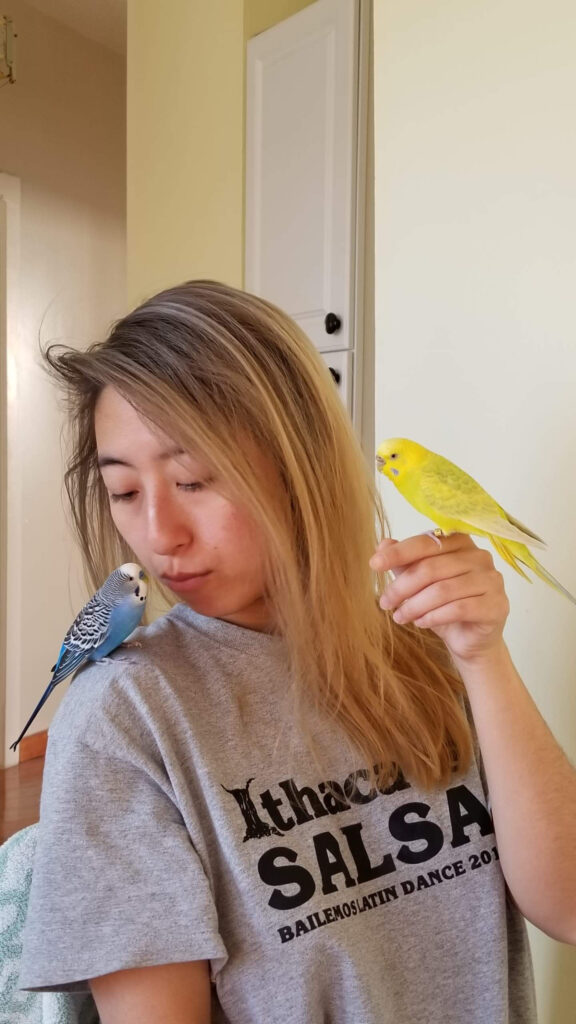
my first two budgies who taught me so much
I have wanted to work with animals for as long as I can remember, so I went to Cornell to study their physiology and nutrition, and stayed on in 2014 to start a PhD on hormones. That was the same year Dapi and FitC came home with me. Everything was perfect.
Three years later, FitC laid an egg. Then she laid another, and another, and by the end of that summer she had laid twenty-four. Over the next three years, she prolapsed more than once and grew an ovarian cyst that nearly killed her. Hormone injections frequently failed, and anyone I asked eventually landed in the same place: some birds are just broken.
I didn’t know it at the time, but that is the answer millions of budgie people get every year, and most have no reason to doubt it. I did. Studying how hormones are made was my whole job, and what I was being told simply was not how biology works.
So I went looking myself. I dug up old research that had been sitting unread and pieced together decades of observations from people who had spent their lives around these birds — and there it was, in plain sight the whole time. Her food, her light, her routine, the way I handled her: every ordinary part of her life was pulling on her hormones. Nobody had thought to check. I changed them, and she stopped, exactly the way the biology said she would.
Then I started sharing what had happened to her, and found out how many people were living the same thing — millions of birds with problems just as serious, and no one looking into any of it. So I built The Budgie Academy, to share real budgie-specific expertise and support with budgie people around the world who care about their birds as much as I care about mine.
I don’t just work with budgies. I live with them!
I know exactly what it’s like to be a budgie person, because I am one! Meet the birds that I live with and learn from every single day.
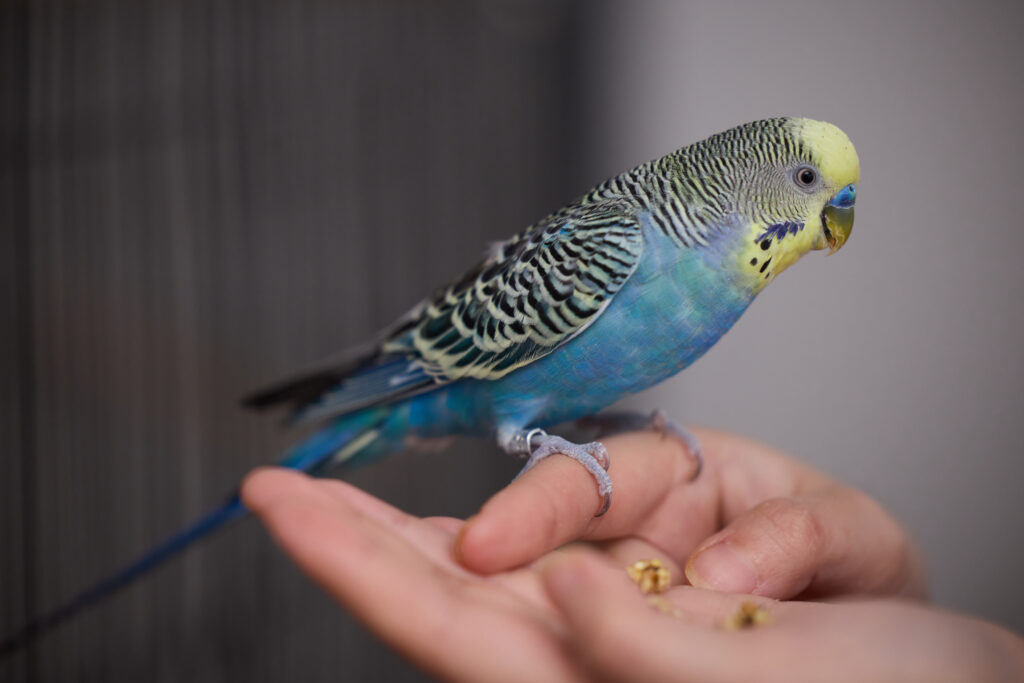
Louie
A friend spotted him in a local Facebook group — a budgie loose on the street near my home. I swiped him off a fence post barehanded, which I don’t recommend without prior experience. He was terrified of me then. He got over it. He promptly bonded with my two cockatiels and has been courting Sydney ever since, undeterred by the fact that he is not remotely her type.
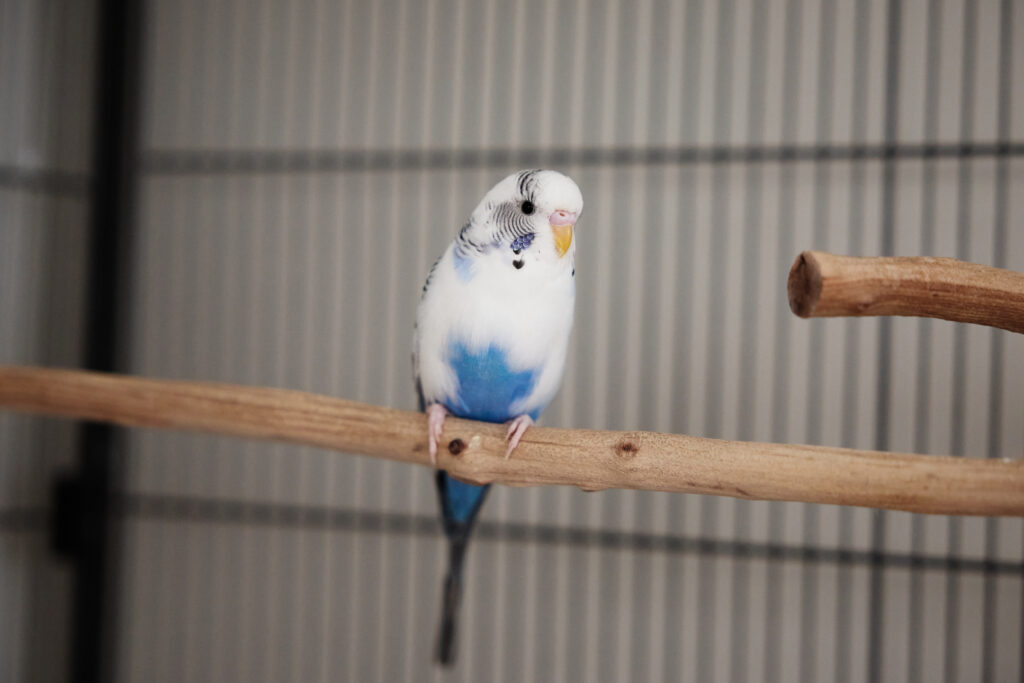
Bino
I adopted him at two and a half to be a companion for Louie, after his previous owner developed an allergy to him. He integrated perfectly and has since dedicated himself to talking to Louie at every possible opportunity. Louie finds him a little much. He is a delightful bird boy, and he’s the one who turns up on my head mid-video the moment he suspects I have something interesting.
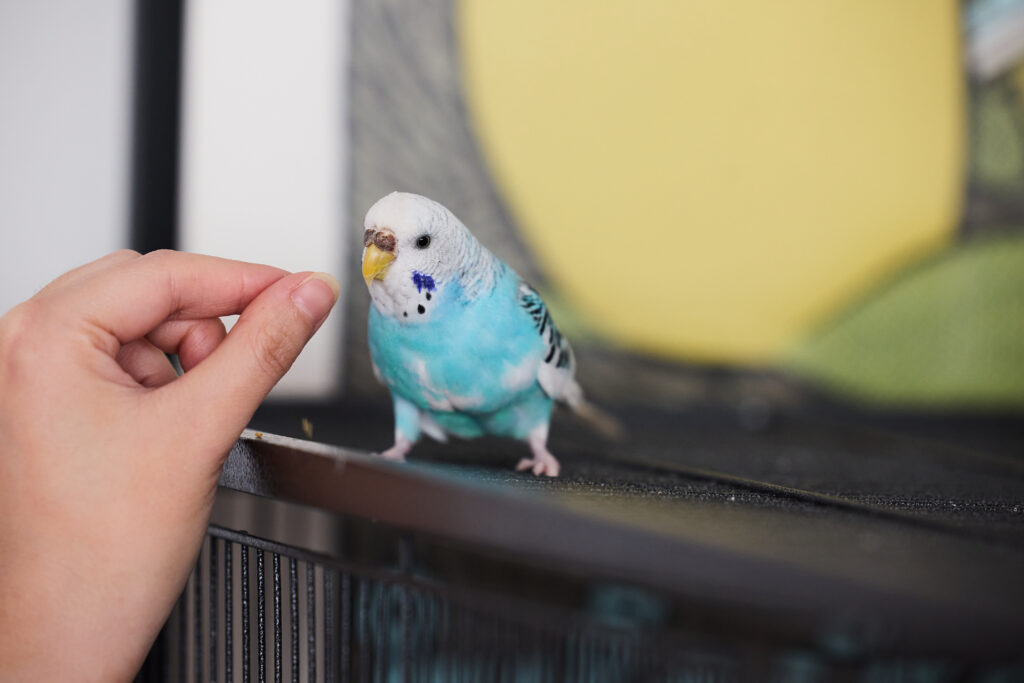
Bluebell
She was found in Boston, emaciated and in shock, with zip ties on both her legs. She was terrified of me when she arrived. A few weeks of integration, training and support later, she blossomed into one of the funniest, spunkiest budgies I have known — and she now attends the daily three-way budgie conference that convenes in here whether I like it or not.
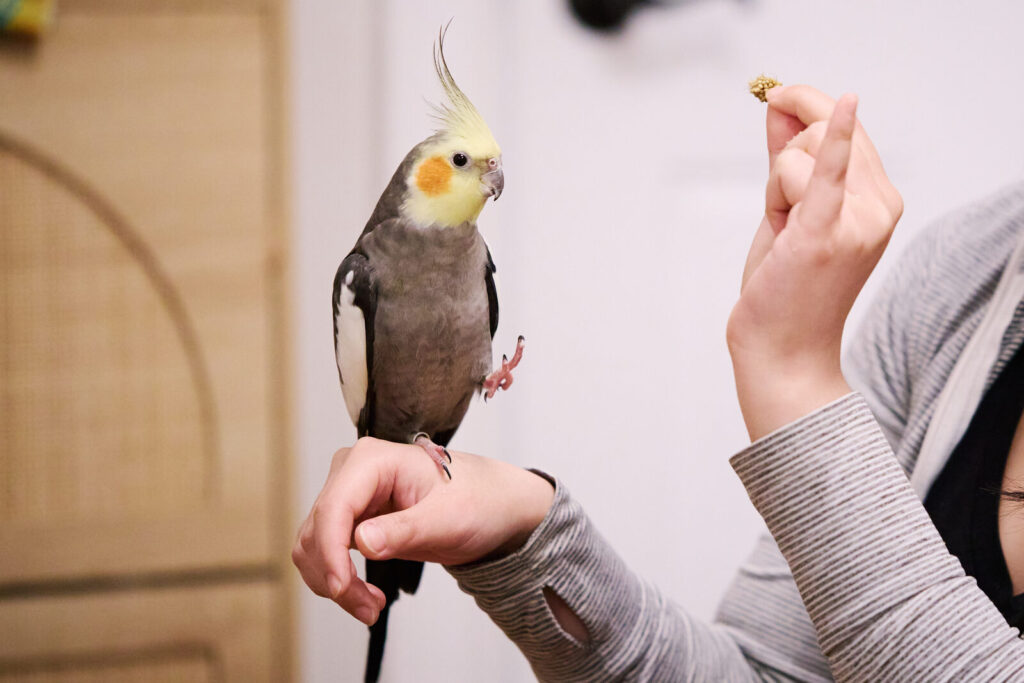
Gandalf
He came to me with severe aggression — flighted attacks, aimed hardest at women, out of a life before mine. He couldn’t be handled and wouldn’t take food from anyone. He was my first cockatiel and my first serious aggression case, and it was a great deal of work. It resolved beautifully. He now goes everywhere I go in the house and supervises the routine personally: if I am not where I am supposed to be, the entire flock hears about it.
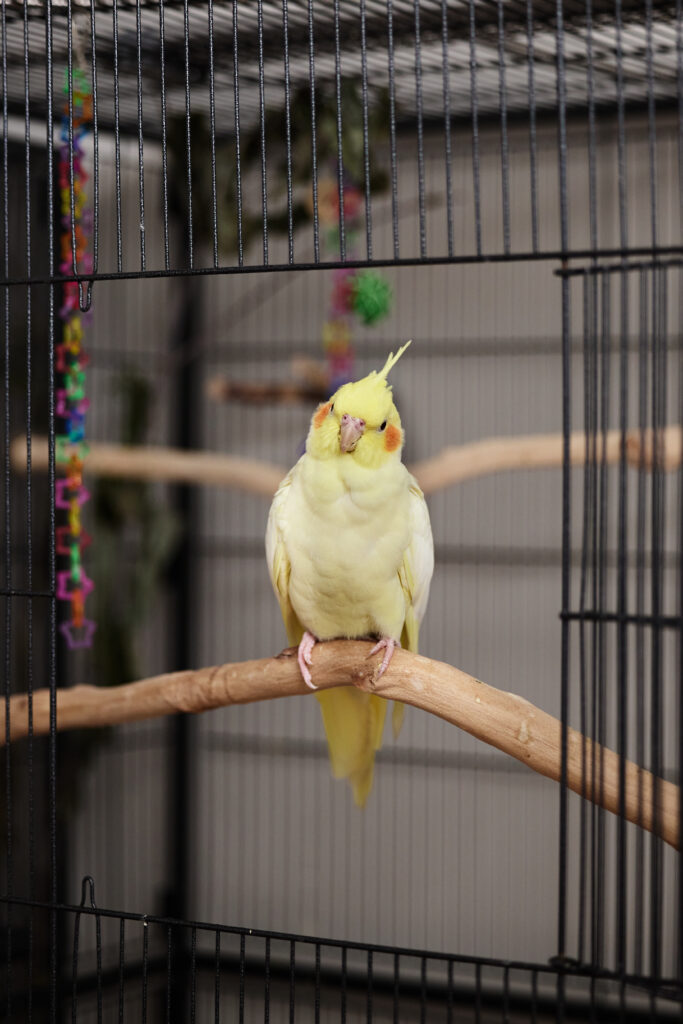
Sydney
Eleven years old and clipped since she was a baby, she flew here from North Carolina barely able to move, with hormone trouble left over from her old home. Then she fell for Gandalf, who had no idea what was happening. It took him a while. They have both since established that they are, in fact, the same species, and now move around the house as a slightly more coherent unit — while remaining entirely themselves.
Passed members

Dapi
He was, honestly, the perfect budgie. Gentle, brilliant, flying to me across the house, saying “pretty bird” and “good boy,” making laser noises and kissy noises and, after a little coaching, a water faucet and R2-D2. He was the first bird I ever saw flare with avian gastric yeast, and his crop never fully settled after. We lost him suddenly to a heart blockage. He is the reason I know what a thriving budgie actually looks like — every bird I have assessed since has been measured, quietly, against him.
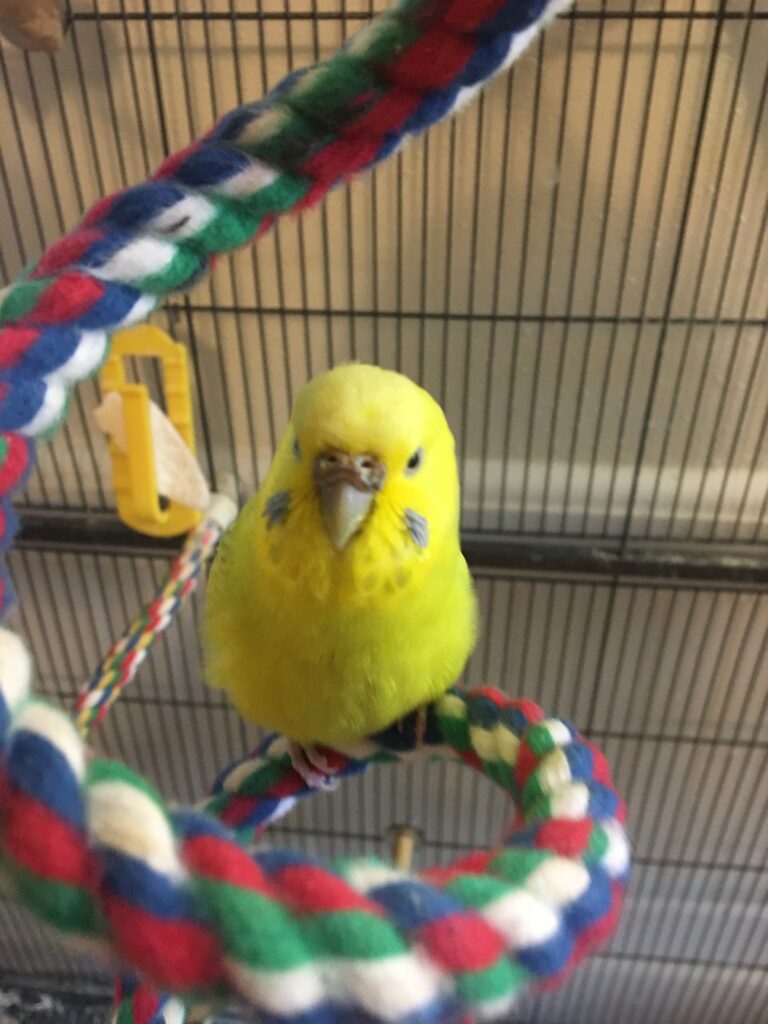
FitC
She was my first budgie with a real personality: she knew exactly what she wanted, exactly when she wanted it, and precisely how to tell me. Through her I learned what female budgies actually prefer and how they actually behave. She chewed every piece of wood she could reach and is the original flying beaver — still the term I use for the demolition work of a hormonal female. She is the reason I started studying parrot hormones at all. I was trying to save her. I did, and then lost her anyway, to something I couldn’t touch.
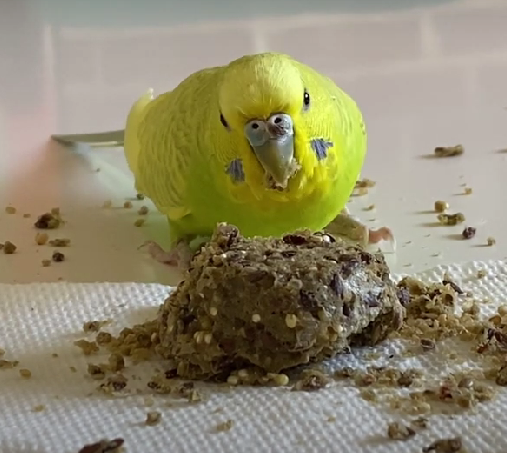
Callie
My best eater. She came to me malnourished and terrified of people, looking honestly horrendous, and carrying a terminal illness none of us knew about. Food, medical care and the diet conversion she needed, and she did fantastically — she became a stunning little bird who threw mahogany pods all over my floor with total commitment.

TritC
She had never left her cage, couldn’t fly, and was terrified of people. She worked out remarkably quickly that humans weren’t merely tolerable but useful — that we would carry her anywhere she wanted to go so she could keep up with the rest of the flock. The joint disease she was born with, the reason she had never flown, kept progressing. When it took her quality of life, we let her go.

Eva
The first budgie I ever flew to collect — I went to Orlando for her, and brought her home through an airport for the first time. She integrated beautifully; she, TritC and FitC became a perfect little female trio. Mostly mellow, but she had pipes on her, and when she had an opinion you knew about it. She passed very suddenly one day in July 2024.
If you’ve read this far, I’d love to meet your budgie.
You don’t need to have it all figured out, and you don’t need to arrive with a crisis. Come tell me about your budgie — the good, the worrying, the “is this normal?” — and let’s find the right way to work together.